
A Defining Threshold for Academic Success
In every child’s educational journey, there are moments that shape how they experience learning and how they perform in school. There is also a profound threshold that can be misunderstood or go unnoticed, and that is the threshold that marks your child’s transition into first grade. This is a moment in their educational journey that is more than just changing classrooms and academic expectations. There is a developmental crossing that happens in this moment that will shape how they experience learning, going to school, and especially how they will see themselves as learners.
When this transition is thoughtfully supported, children are able to step into first grade with confidence, enthusiasm, curiosity, and a sense of belonging. When it is ahead of their developmental needs, they will internalize feelings of inadequacy, show anxiety, or perhaps even resist learning and going to school, which could echo throughout their schooling journey.
Let’s dive in to better understand why this transition matters and why honoring the young child’s developmental phases, especially in their early years, is essential to their academic success. But first, let’s explore schooling and its relationship to continuity.
First grade is often described as the time when “real” school begins, and this framing can unintentionally diminish the value of their early childhood education. In reality, the transition from early childhood to first grade is an important threshold, a crossing from one mode of learning to another. When first grade honors what came before, children experience continuity, and this is a time in their educational journey when we support growth as their confidence builds. When your child enters first grade, one of the most important developmental shifts happens, and this is the gradual change from will-based learning in early childhood to thinking-based learning. Because first grade introduces abstract concepts like letters, numbers, and symbols, by nature, it demands sustained abstract thinking. At Hundred Hills School, the transition into first grade introduces abstract concepts gradually and imaginatively at a developmentally appropriate time, which gives children the sense of being capable. The other side of this is the child who is rushed, who may be distracted, and become resistant or anxious when, in actuality, they are being stretched too far. Truth is, the roots of sustained abstract thinking happen before abstract concepts are introduced. It happens in the young child’s early childhood years in their will, their body, and in their imagination.
At Hundred Hills School, we understand that when early childhood education is play-based, developmentally aligned, and also followed by a developmentally appropriate transition to first grade, children are truly ready for academics. Understanding why this moment in your child’s school journey matters so much helps in understanding why we protect what drives academic success, and that is, a holistic perspective of the “Whole” child’s physical, emotional, and cognitive needs.
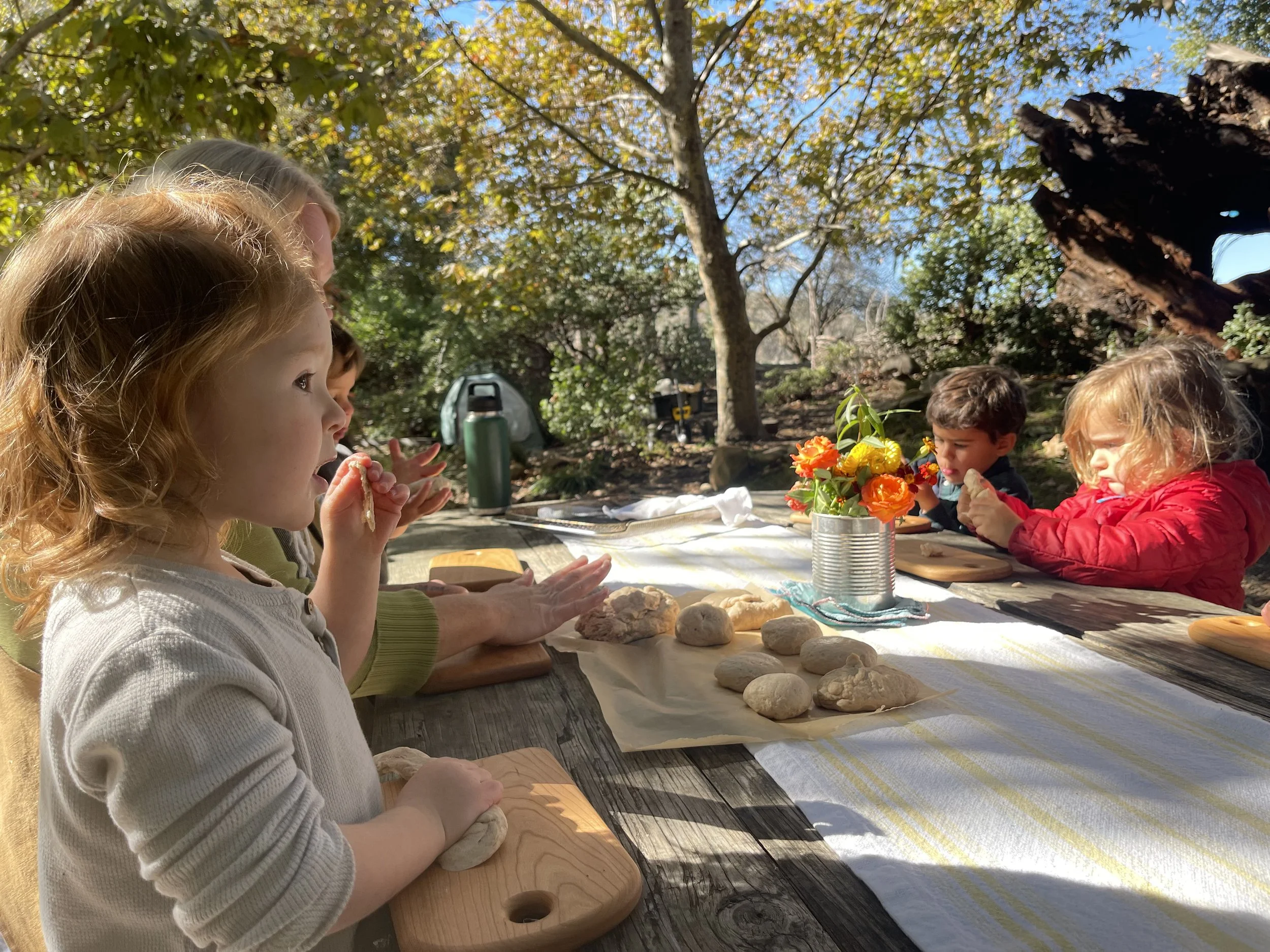
At Hundred Hills School, we know that in early childhood, children are not ready for sustained abstract thinking, and so we teach the skills that will make abstract learning more quickly attainable and with greater joy. Our early childhood programs focus on building each child’s attention, focus, memory, sequencing, language, comprehension, emotional regulation, motivation, and perseverance, as well as body awareness, endurance, and physical coordination. These are critical skills that are both neurological and developmental prerequisites for academic learning, and this is backed by research. We know that an early childhood education that prioritizes learning through play, movement, connection, and relationship, all within healthy breathing rhythmical days, allows for a more robust emergence of academic skills. And let’s not forget about the importance of eating nutritious, health-giving food that actually nourishes the brain and body.
Research shows us that it is imaginative, independent, and social play that develops neural pathways essential for later academic work, and that play strengthens cognitive capacities like executive function, language development, problem-solving skills, and symbolic thinking that will be needed for later academic work. These are the very capacities that directly support reading, comprehension, writing, and the understanding of mathematical concepts.
There are two important contributions of a play-based early childhood experience. One contribution is the cultivation of intrinsic motivation. Children who learn through play develop an inner drive to explore and understand. They learn because they want to, not because they are rewarded or pressured. The other contribution is the development of abstract thinking. Here’s an example, when a child pretends that a wooden block is a phone or a loaf of bread, or a stick is a horse or a magic wand, they are learning that one thing can represent many things and this ability is foundational to abstract thought. It helps children understand that letters represent sounds, numbers represent quantities, and symbols can represent ideas. This is why children who have had rich imaginative play in their early years often grasp academic symbols more deeply because their thinking has been prepared from the inside out, not the outside in. Without this groundwork, how a child learns may very well lean more towards memorization and lack a solid understanding. Without this groundwork, learning easily becomes more fragile and likely to break down under pressure.
At Hundred Hills school, we also understand that a child’s physical body must also be readied for academic success. Before children can sit and think, they must first move, create, and do things with their hands and body. Our play-based early childhood education strengthens the body through climbing, balancing, jumping, rolling, digging, carrying as well as self-directed movement and these are activities that support each child’s core strength and posture which will be needed for sitting and writing when academic learning begins. It supports the development of each child’s fine motor skills. It supports coordination which is linked to reading fluency and it supports spatial awareness not only essential for math but also for awareness of where the body is in space.
Academic learning is not just a mental act to be assessed and graded, it is a child’s whole body experience. This is why an education that nourishes head, heart, and hands is holistic in its approach to educating the whole child. At Hundred Hills school, our play-based early childhood classrooms offer predictable rhythms, warm relationships, and joyful learning experiences. This emotional security allows the nervous system to remain regulated which is essential for attention, memory, as well as a deep interest in learning which later improves academic success. It’s no surprise that when children associate learning with joy they are more likely to engage deeply and persist even when learning becomes challenging later on.
At Hundred Hills school, first grade does not abandon the strengths of our early childhood education, instead we build upon them. We believe that the most effective first grade classrooms do not eliminate play but instead transform it. In our first grade classroom, learning becomes more structured, but still imaginative and experiential where letters emerge from stories and images, numbers arise from rhythm, movement, and real-life experiences, writing begins with drawing and forms before abstraction, and lessons engage head, heart, and hands.
Research shows that a first grade experience that honors play, storytelling, movement, and experiential learning helps children step into the beginnings of their academic journey without fear. This is what builds confidence and fuels long-term academic success.
True academic success is not achieved by pushing children ahead of their development. It arises when development is understood, respected, and supported. When early childhood education is rooted in rhythm, play, movement, and imagination, and the threshold to first grade is honored, it’s not about delaying academics, it’s what defines the quality of the education. Let’s remember that academic success is not about early performance, instead it’s about sustained engagement, depth of understanding, and perseverance. It’s an education that nurtures resilience!
By Chinyelu Kunz
Joint Head of School