
Top 5 Things to Look for When Choosing a School for Your Child
Choosing a school for your child is one of the most important decisions you will make as a parent and it’s not all about academics. Schools shape how a child experiences learning, relationships, creativity, as well as how they feel about themselves. The education that your child receives greatly impacts their sense of self. Education is not only about preparing children for tests or the career they will choose, it is about nurturing the whole human being: head, heart, and hands. So rather than asking, “What does my child need to push them to achieve?” This article invites you to ask, “How can I best support my child in their becoming?”
Below are five essential qualities to look for when choosing a school that focuses on the long‑term well-being and healthy development of your child. One that respectfully honors each child’s natural unfolding.
1. Is the school rooted in a deep understanding of child development?
The first step to take when choosing a school is to examine whether the educational foundation is rooted in a deep understanding of child development. Is the education rooted in the understanding that children grow in distinct developmental phases: physically, emotionally, socially, and cognitively? Does the education meet the children where they are, or does it rush them ahead?
If you’re looking for an early childhood program, it’s critical to choose a developmentally aligned school that will prioritize imaginative play, rhythm, routine, and meaningful work over early academics. Young children learn best when they feel safe, unhurried, and connected because learning happens primarily through imitation, movement, play, and sensory experience.
As children move into the elementary years, their capacity for imagination, feeling, and relationship deepens. Does the school support this stage through rich storytelling, artistic expression, and hands‑on learning? Do the lessons speak to their sense of wonder? Rather than choosing a school that introduces abstract instruction too early in a child’s young years, children enjoy school when learning is brought through images, movement, music, and story.
3 questions to ask yourself:
Does the school honor the developmental needs of children at each age?
Are expectations age‑appropriate, or do children seem rushed or pressured?
Is learning designed to support the whole child, not just intellectual performance?
Hundred Hills School is grounded in child development and recognizes that strong academic thinking emerges most naturally when children are given time to grow and when they are given time to move, imagine, and feel deeply in their early years.
2. Does the school value relationship building with the students?
A school that values relationship building with its students not only creates emotional safety, it creates a safe learning environment. Children learn best when they feel emotionally safe, seen, and understood. Schools should be a place where children feel a sense of belonging and trust, where they are valued not just as students, but as individuals with different strengths and gifts.
Look for a school that values long‑term relationships between teachers and students as this continuity allows teachers to deeply understand each child’s strengths, challenges, and growth over time. Look for a school that focuses on guidance, repair, and an understanding that behavior is communication; where children are supported in learning how to navigate conflict, take responsibility, and develop empathy.
3 questions to ask yourself:
How do the teachers speak to children?
Are children treated with respect and dignity?
How does the school respond to mistakes or challenges?
At Hundred Hills School, we prioritize each child’s emotional well-being. We understand that confidence, resilience, and self‑regulation grow out of secure relationships and that when children feel emotionally held, they are free to deeply engage in learning.
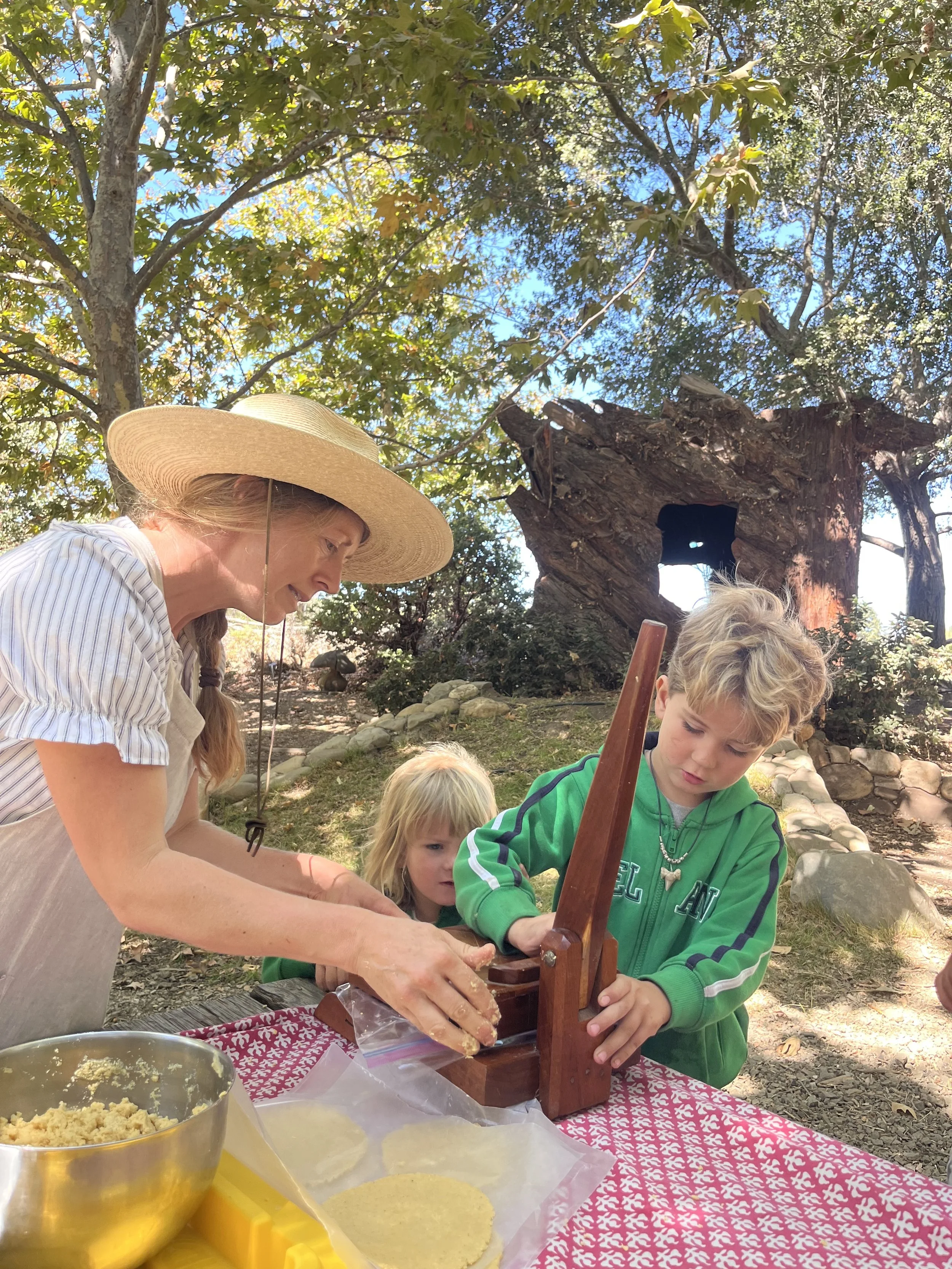
3. Does the school offer a rich, imaginative, and hands‑on curriculum?
A school that places a high value on imagination, creativity, and experiential learning creates an environment where children are not passive recipients of information but active participants in their education. A school where learning is brought through stories, art, music, movement, handwork, practical skills makes learning meaningful.
Rather than separating academic subjects from creative ones, an inspired education integrates them. Math, language arts, science, and history can be taught in ways that engage the whole child. For example, math can be learned through rhythm, movement, and visual patterns, history through storytelling and art, science through observation and hands‑on exploration. This approach to educating a child supports not only academic understanding, but also creativity, and problem‑solving, and it increases joy in learning. A school that gives children opportunities to work with their hands, like knitting, woodworking, gardening, cooking greatly supports the development of patience, coordination, and a sense of competence.
3 questions to ask yourself:
Does the curriculum invite curiosity and imagination?
Are children actively engaged, or primarily sitting and absorbing information?
Is there a balance between intellectual, artistic, and practical learning?
At Hundred Hills School, you’ll discover a rich, hands‑on curriculum that nurtures children to not only seek knowledge, but also be creative, adaptable, and connected to the world around them.
4. Does the school nurture healthy rhythms and respect for childhood?
We live in a culture that values speed, productivity, and constant stimulation; children need schools that intentionally protects the pace of childhood. When the pace of childhood is protected, it is respected as a precious time in development. Rhythm is a cornerstone in honoring childhood as predictable rhythms help children feel secure, grounded, and oriented in time.
A school that is aligned with these values will honor unstructured play, outdoor time, and natural transitions throughout the day. Rather than over-scheduling or overstimulating children, a school that creates space for breathing, movement, and rest respects the needs of children.
3 questions to ask yourself:
Does the school allow children time to play freely?
Is there regular outdoor time in all seasons?
Does the pace of the day feel calm and intentional, or rushed and overwhelming?
At Hundred Hills School, we respect childhood and recognize that children do not need to grow up faster to succeed. We know that when childhood is honored, children develop a strong inner foundation that supports lifelong learning and their well-being.
5. Does the school value being in partnership with parents?
Finally, choosing a school is not just about choosing an education for your child, it is about entering into a relationship with a community. Does the school view parents as partners in the educational journey of their child and not simply consumers of a service? Does the school value open communication, parent education, and collaboration? Look for a school that is aligned with your values. Get to know about the school through their offerings like, parent evenings, workshops, as well as opportunities to learn more about child development and the educational philosophy. While no school will match every family perfectly, a shared understanding of childhood, learning, and growth creates coherence for the child. When home and school speak a similar language, children feel secure and supported.
3 questions to ask yourself:
Does the school communicate its values clearly?
Do you feel welcomed and respected as a parent?
Does the school encourage a partnership rather than pressure or comparison?
At Hundred Hills School, we believe that education is most powerful when it is rooted in trust, shared values, and a mutual respect between the educators and families.
Choosing a school is a statement about what you believe your child needs to thrive, not just now, but for the rest of their lives. We believe that one of the most important questions is not how early a child learns to read or how quickly they advance academically, but whether they are given the conditions to grow into healthy, capable, compassionate human beings.
When a school honors child development, prioritizes emotional safety, offers rich and imaginative learning, protects the pace of childhood, and partners with parents, it creates an environment where children can truly flourish. In choosing such a school for your child, you are not only choosing an education, you are choosing an important part of your child’s childhood.
By Chinyelu Kunz
Joint Head of School